
In short. How surgeons choose between direct closure, skin grafts, local flaps and free tissue transfer, and why the simplest repair that will work is usually the right one.
Key points
- The best reconstruction is usually the simplest one that will reliably work.
- A graft is quick and dependable but needs a healthy bleeding bed, and it never quite matches surrounding skin in colour or texture.
- A local flap brings its own blood supply and matches better, at the cost of extra scars and a longer operation.
A wound is not simply a hole. What matters is how deep it goes, what lies exposed underneath — bone, tendon, cartilage, nerve or blood vessel — whether the tissue around it is healthy, and how much tension a repair would place on the surrounding skin. Surgeons compare these features against a hierarchy of repairs known as the reconstructive ladder, and understanding that ladder makes it much easier to follow the plan you are offered.
What the ladder describes
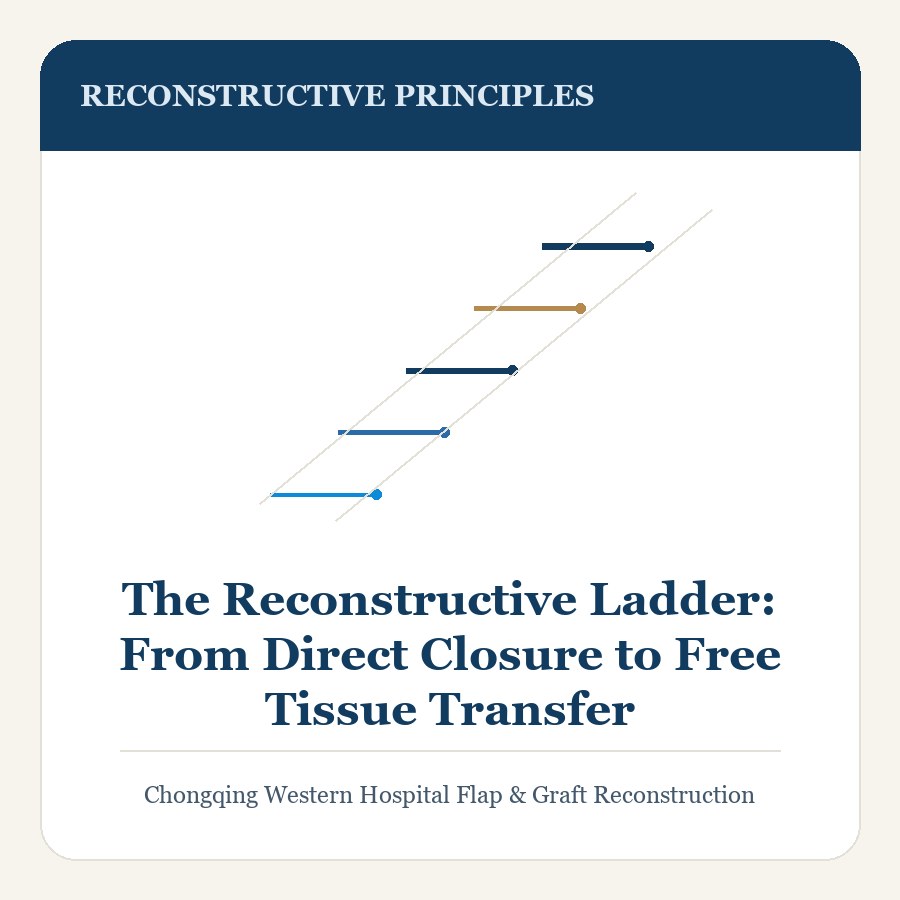
The ladder runs from the simplest repair that might work to the most complex. At the bottom sits healing by itself, then direct closure of the wound edges with sutures, then skin grafting, then local and regional flaps, and finally free tissue transfer, in which a block of skin, fat, muscle or bone is moved with its own blood vessels and reconnected under a microscope. Each rung upward buys more tissue and better cover, and costs more operating time, more risk and more scars.
How the rung is chosen
Four questions decide it. Can the wound edges be brought together without distorting a nearby structure? Is the wound bed good enough to feed a graft? Is there exposed structure that a graft cannot cover, because a graft survives only on a living bed? And is there enough nearby tissue that can be moved without deforming something that matters? A shallow wound on the thigh and an open fracture of the tibia are both defects, but they sit at opposite ends of the ladder.
Climb only as high as the wound demands
The best reconstruction is usually the simplest one that will reliably work. A graft is quick and dependable but needs a healthy bleeding bed, and it never quite matches surrounding skin in colour or texture. A local flap brings its own blood supply and matches better, at the cost of extra scars and a longer operation. A free flap can rebuild almost anything but takes many hours and carries a small risk of complete loss. Choosing well means weighing the defect, your general health, and what you are willing to go through, rather than demonstrating the most advanced technique available.
Staging and anaesthesia
Small closures and grafts are often done under local anaesthesia. Flaps and free tissue transfer need general anaesthesia and a full operating theatre. Reconstruction is frequently staged: a first operation to clean and stabilise the wound, a second to rebuild, and sometimes later refinements. Staging is planning, not failure, and it is common for the final plan to differ from the first one.
What reconstruction can and cannot do
It can close wounds that would never heal on their own, cover exposed vital structures, restore contour, and protect movement. It cannot reproduce the tissue that was lost. Grafts differ in colour and texture, flaps carry scars of their own, and sensation in transferred skin is always reduced. Judgement at six to twelve months is the honest benchmark, and no outcome is guaranteed.
Seek review promptly if
- A graft or flap turns dusky, purple or black, or becomes cold and swollen, because blood supply problems are time-critical.
- Fever, spreading redness, increasing pain or discharge develops around the reconstruction.
- A wound that was healing opens again, or a healed area breaks down without any injury.
Frequently asked questions
Why is the simplest reconstructive option not always chosen?
A hierarchy of repairs running from the simplest to the most complex: healing by itself, direct closure with sutures, skin grafting, local and regional flaps, and finally free tissue transfer with its blood vessels reconnected under a microscope. Each rung upward buys more tissue and better cover, and costs more time, risk and scarring.
Why not always use the most advanced technique available?
Because the best reconstruction is usually the simplest one that will reliably work. A graft is quick but needs a healthy bleeding bed. A free flap can rebuild almost anything but takes many hours and carries a small risk of complete loss. The rung is chosen by the defect, your health, and what you are willing to go through.
Why is reconstruction sometimes done in stages?
A first operation may clean and stabilise the wound, a second rebuild, and later stages refine. Staging is planning rather than failure, and it is common for the final plan to differ from the first one. It is also frequently the safest route to a durable result.
Risks & Limitations
- Partial or complete failure of a graft or flap, which may need further surgery.
- Donor-site scarring, delayed healing and pain. A donor site leaves its own permanent scar.
- Infection, bleeding under a graft, or fluid collecting beneath a graft or flap.
- Contracture, and recurrence of contracture after a release procedure.
- Reconstruction is usually staged: more than one operation and months of healing are normal.
- Colour, texture and contour mismatch between reconstructed skin and the surrounding area.
- Reduced or altered sensation in grafts, flaps and donor sites.
- Scars are permanent. They mature and fade but never disappear.
- Final assessment is made at 6–12 months, and longer in growing children.
When to Seek Care
- A graft or flap that turns dark, cold, dusky, purple or black, or stops bleeding when pricked.
- A dressing soaked with blood, or bleeding that does not stop with gentle pressure.
- Fever above 38 °C, or spreading redness, warmth or discharge around a wound.
- New or severe pain, or rapid swelling under a graft or flap in the first days.
- A limb that becomes pale, cold or numb after flap surgery.
- Any change in a grafted or flap-covered area that concerns you, however minor.
References & Further Reading
- American Society of Plastic Surgeons (ASPS) — reconstructive surgery and skin graft guidance
- Cochrane Library — systematic reviews in wound care and surgical reconstruction
- Wounds International — wound bed preparation and graft survival guidance
- Chinese Medical Association, Plastic Surgery Branch — clinical guidance
This page is patient education, not medical advice, and it does not cite individual studies. Discuss your own case with a qualified clinician. To arrange an assessment at Chongqing West District Hospital, see Contact & Consultation.